



Meta’s October 15 release of Muse Spark Open introduces more than another large AI model. Developed by Meta Superintelligence Labs, the 816-billion-parameter model is designed for advanced reasoning, coding and agentic workloads. However, one of the most interesting developments accompanying the release is Apple’s demonstration of the model running across two and four Mac Studio systems.
The collaboration highlights how advances in model architecture, quantization and memory technology are expanding the hardware options for large-model inference. While NVIDIA and AMD dominate high-performance AI acceleration, Apple’s unified-memory architecture and Intel’s CPU-based inference efforts illustrate how the market is evolving beyond conventional GPU configurations.
A Massive Model With Reduced Compute Requirements
Muse Spark Open uses a sparse mixture-of-experts (MoE) architecture containing 816 billion total parameters, with approximately 42 billion activated per token. This approach significantly reduces computational requirements compared with a similarly sized dense model while preserving access to a much larger collection of specialized parameters.
However, fewer active parameters do not eliminate the need to store the model’s weights. The BF16 version requires more than 1.6TB of memory for weights alone, while Apple’s implementation of the NVFP4 quantized model reduces the footprint to approximately 493GB.
This distinction between compute requirements and memory capacity is becoming increasingly important as AI infrastructure shifts toward inference workloads. Large MoE models require systems capable of storing enormous parameter sets while efficiently accessing and processing relatively small portions of those models during execution.
Apple Demonstrates Distributed Inference
Working with Meta, Apple demonstrated Muse Spark Open running across two Mac Studios equipped with M5 Ultra processors and 512GB of unified memory each.
Unlike conventional GPU servers that use discrete accelerators with dedicated high-bandwidth memory, Apple’s architecture provides a shared memory pool accessible by the CPU and GPU. This enables large memory configurations without requiring equivalent amounts of dedicated GPU memory.
Apple used its MLX machine learning framework and Remote Direct Memory Access (RDMA) over Thunderbolt 5 to distribute inference workloads across multiple systems.
The company reported the following results using an 8,192-token context:
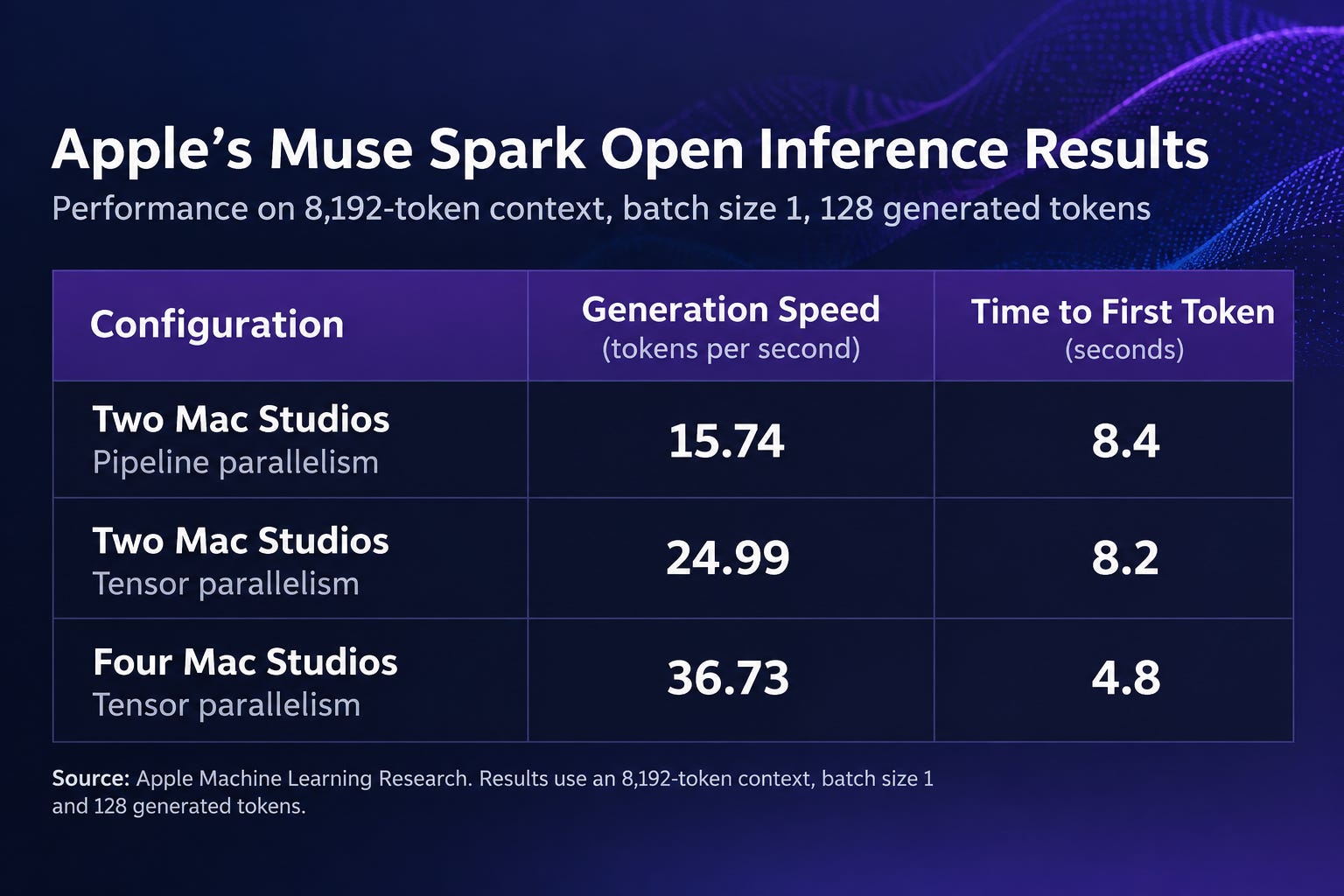
These results demonstrate that distributed desktop systems can deliver interactive inference performance on a model containing more than 800 billion parameters.
Although the measurements do not establish cost or performance parity with dedicated GPU servers, they demonstrate the growing practicality of local inference for workloads requiring substantial memory capacity.
A Broader Hardware Opportunity
Meta is supporting Muse Spark Open across NVIDIA, AMD, Intel and Apple platforms, demonstrating that large-model inference is not restricted to a single processor architecture.
NVIDIA’s Blackwell accelerators and AMD’s Instinct GPUs provide the high-bandwidth memory, computational performance and interconnect capabilities needed for large-scale inference deployments. These platforms are particularly well suited to serving multiple users and agents concurrently.
Intel represents another approach. Meta includes Intel Xeon 6 processors among its supported platforms, using INT4 quantization to enable CPU-based inference. While CPUs are unlikely to match high-end GPU systems in throughput for models of this scale, they offer an alternative for organizations seeking to use general-purpose server infrastructure for AI workloads.
The range of supported architectures illustrates an important development: inference optimization is increasingly about matching hardware characteristics to specific workload requirements rather than assuming every model requires the same accelerator configuration.
TIRIAS Take
Meta’s Muse Spark Open release is an important milestone for large-model inference, particularly because of what it demonstrates about the relationship between model architecture and hardware design.
Apple’s results show that distributed desktop systems can deliver usable inference performance on an 816-billion-parameter model. The combination of unified memory, high memory bandwidth and Thunderbolt 5 interconnects expands the possibilities for locally operated AI infrastructure.
However, the demonstration also reinforces the distinction between running a model and operating it economically at scale. NVIDIA and AMD remain well positioned for high-throughput, multiuser environments, while Intel’s CPU-based approach and Apple’s unified-memory systems provide alternatives for workloads with different performance, capacity and deployment requirements.
TIRIAS Research expects AI inference infrastructure to become increasingly diverse as organizations balance performance, memory capacity, power consumption, data control and infrastructure costs. This will be particularly important as agentic applications introduce new demands for sustained inference, large context windows and concurrent execution.
The next phase of AI infrastructure competition will not be determined solely by accelerator performance or the size of models a system can accommodate. The more meaningful measures will be how many users or agents a system can effectively support and the cost of completing useful work.
Meta’s announcement demonstrates that the range of viable hardware architectures is expanding. Determining which architecture delivers the best economics for each workload will be the next challenge.