


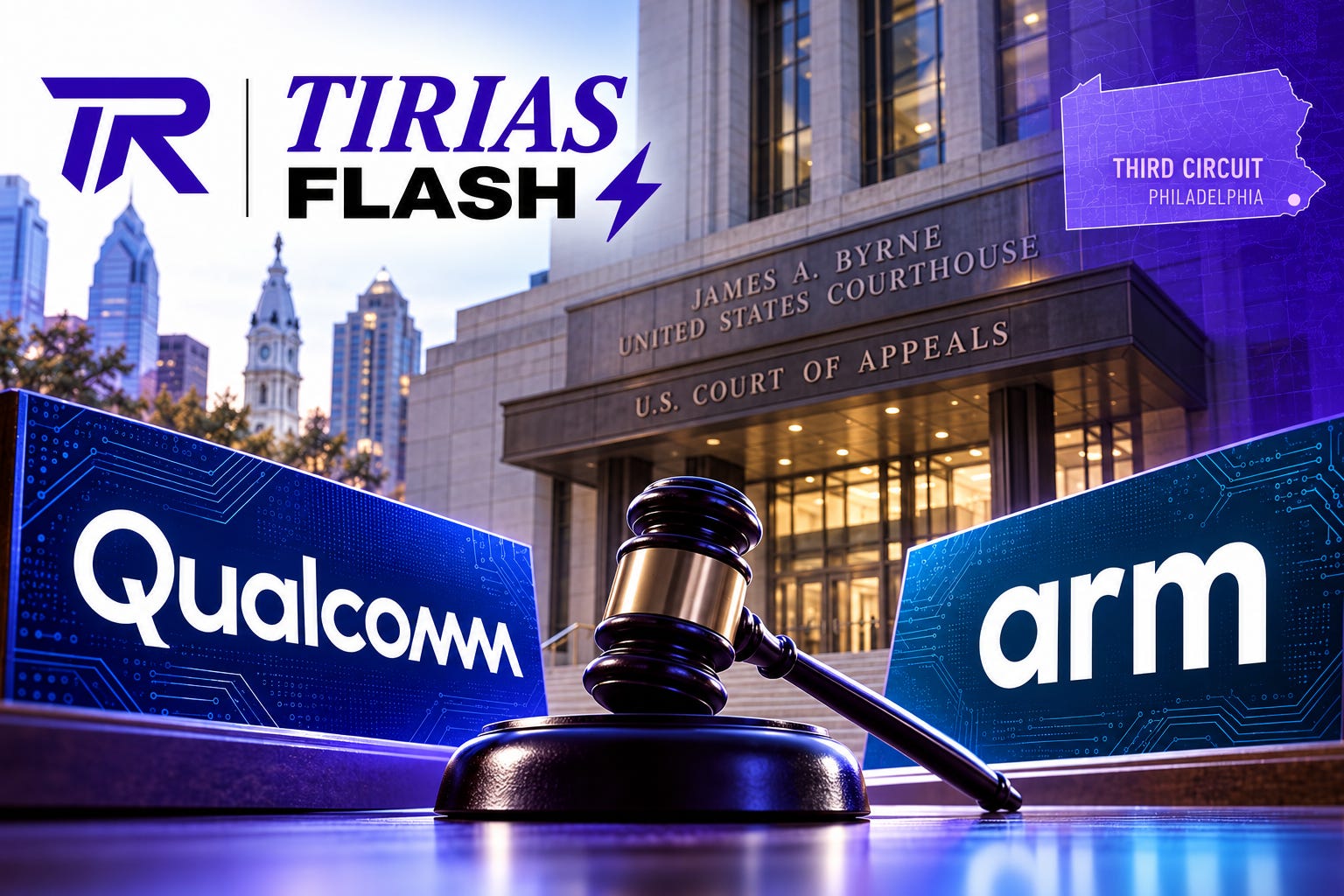
The legal battle between Arm and Qualcomm continues on multiple fronts. While attention recently focused on their October 2026 trial, a separate dispute dating back to Qualcomm’s acquisition of Nuvia remains unresolved.
On Wednesday, October 21st the U.S. Court of Appeals for the Third Circuit heard oral arguments challenging the outcome of the December 2024 trial, which centered on whether Qualcomm could use processor technology developed by Nuvia under Qualcomm’s existing Arm Architecture License Agreement (ALA).
The 2024 jury found in Qualcomm’s favor on the licensing of its custom CPU cores but deadlocked on whether Nuvia had breached its own agreement with Arm. The district court subsequently entered judgment against Arm on the unresolved Nuvia claim.
The Licensing Question
At the center of the appeal is the meaning of technology “developed by or for Qualcomm.”
Arm argues that processor designs incorporating RTL code originally developed under Nuvia’s separate license cannot automatically qualify under Qualcomm’s ALA. Qualcomm maintains that its agreement permits the use of acquired code in processors subsequently developed by Qualcomm.
During oral arguments, Judge Peter Phipps questioned whether the agreement’s language required technology to be solely developed by Qualcomm. The question has broader implications for semiconductor development, where companies routinely integrate internally developed technology with intellectual property obtained through acquisitions.
The Procedural Questions
The appellate judges also scrutinized how the original trial handled Arm’s arguments.
One issue is whether Arm forfeited its right to challenge the interpretation of the licensing agreement by participating in jury instructions.
Another concerns the district court’s treatment of evidence of financial harm. Arm argued that Qualcomm’s acquisition of Nuvia was expected to save approximately $1.4 billion in royalties. The appellate judges questioned whether royalty-related evidence could be excluded from consideration when the jury had received no instruction restricting its use.
The court also explored whether Arm could obtain the specific performance remedy it seeks, even if it establishes a contractual breach.
The appellate panel took the matter under advisement without issuing a ruling.
TIRIAS Take
The appeal raises fundamental questions about how semiconductor companies acquire, integrate and license processor technology. Qualcomm’s acquisition of Nuvia illustrates the challenges of incorporating intellectual property developed under one licensing agreement into products covered by another. For an industry built on acquisitions, engineering talent and reusable technology, the implications extend well beyond Qualcomm and Arm.
The separate October 2026 litigation adds another dimension, challenging Arm’s licensing practices and its relationships with customers. Together, the cases highlight growing tensions between Arm’s control over its architecture and its customers’ desire for greater independence in processor development.
For Qualcomm, the priority is protecting its investment in custom CPU development and the freedom to leverage acquired technology. For Arm, it is preserving the contractual protections and licensing structure underlying its business model.
Regardless of the appellate outcome, these disputes underscore a larger industry challenge: balancing intellectual property rights with the flexibility semiconductor companies need to innovate, acquire technology and compete.