


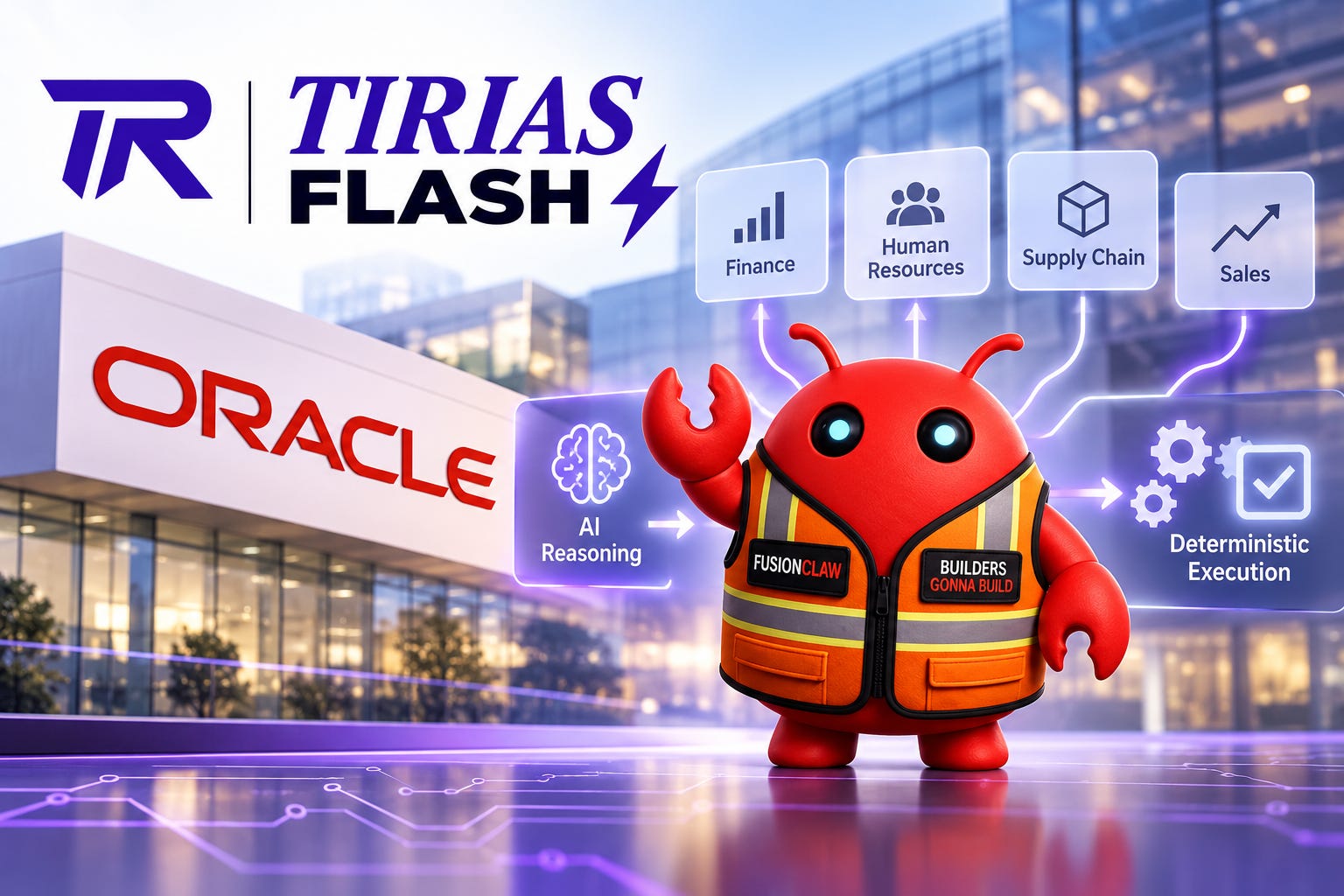
Oracle is extending its Fusion Cloud Applications portfolio with Fusion Claw, a governed agentic execution runtime designed to allow AI agents to handle longer-running and more complex enterprise work.
The announcement includes 25 new Claw-powered Fusion Agentic Applications across finance, human resources, supply chain and sales. These join a broader portfolio of 75 Fusion Agentic Applications. But the more important development is the architecture Oracle is putting underneath them.
Fusion Claw combines frontier-model reasoning with deterministic enterprise computing. An AI model handles tasks that require reasoning, planning and adaptation, while traditional software handles calculations, transactions and other operations where repeatability and precision matter. Oracle says Fusion Claw currently supports models from OpenAI and Google Gemini, with additional models planned.
That separation addresses one of the fundamental challenges with enterprise agents.
Large language models are useful because they can interpret ambiguous information, reason across multiple inputs and adjust plans when circumstances change. Those same characteristics make them poorly suited to independently executing every part of a financial, HR or supply-chain process.
Enterprise systems already contain decades of deterministic business logic. Replacing that logic with AI makes little sense. The more practical architecture is to let AI determine what needs to happen, then use deterministic software to perform the portions of the workflow that require precision.
Oracle is taking a pragmatic approach by building on the business logic, transactional systems and governance capabilities already embedded in Fusion Applications. Rather than attempting to replace those systems with probabilistic AI, Fusion Claw places AI reasoning above an established execution environment.
From Systems of Record to Systems of Outcomes
Oracle describes its Fusion Agentic Applications as moving enterprise software from a “system of record” toward a “system of outcomes.” Rather than requiring a person to navigate applications, analyze information and manually execute a series of steps, the user defines an objective and the agentic application coordinates the work required to reach it.
Examples include reconciling accounting exceptions, creating workforce staffing plans, optimizing shipping consolidation and developing sales territory plans. These are not single-prompt tasks. They involve data gathering, modeling, decision-making, execution and potentially continuous replanning as conditions change. This is where Fusion Claw becomes more significant than another collection of AI assistants.
Delegating Authority Becomes the Hard Problem
As agents gain the ability to execute work, enterprises need mechanisms to define exactly what those agents are allowed to do.
Oracle addresses this through what it calls an Enterprise Operating Envelope, which defines objectives, policies, permissions, risk thresholds, approval requirements and escalation boundaries. An Outcome Trust Harness applies those controls during execution, while an Outcome Receipt records the authority used, evidence considered, decisions made and transactions performed.
Customers can determine the level of autonomy granted to an application, ranging from assistance to automated execution within explicitly delegated authority. This governance layer is important because enterprise agent adoption increasingly becomes less about whether an AI model can perform a task and more about whether an organization is willing to give the AI permission to perform it.
The challenge for Oracle will be demonstrating that these applications consistently deliver measurable business outcomes across complex customer environments. Enterprise workflows rarely operate entirely within a single application, and coordinating work across organizational and software boundaries will become an important measure of success.
TIRIAS Take
Fusion Claw illustrates where enterprise agent architecture is heading.
The first generation of enterprise generative AI largely placed copilots beside existing applications. The next generation embeds agents into the operational layer itself, where they can coordinate workflows and execute transactions.
But AI agents will not replace deterministic enterprise software. They will increasingly orchestrate it.
The emerging enterprise AI stack requires more than powerful models. It needs a dependable execution layer connecting AI reasoning to existing applications, data, business rules and organizational authority. Oracle’s Fusion Claw is a significant example of that architecture taking shape.
Oracle has an important advantage in this transition. Its enterprise applications already contain the business logic, transactional infrastructure, security models and operational data required to execute complex business processes. As AI agents become more capable, those existing assets become more valuable, not less.
The question is no longer whether AI can reason about enterprise work, but how effectively software vendors can turn that reasoning into reliable, governed execution.